


Binance announced on October 13, 2026, that Binance Pool and related services will close on November 10, 2026, at 07:00 UTC. The shutdown includes Cloud Mining, Pool Savings and Transaction Accelerator. Miners should redirect their equipment before Binance’s mining endpoints are disabled (official announcement).
For Bitcoin miners looking for Binance Pool alternatives, Braiins Pool, f2pool and ViaBTC are candidates to evaluate. Start with equipment compatibility, reward and payout rules, and connection quality from your mining location. Use the time before the deadline to narrow your shortlist and test your preferred option.
Which mining pools should you consider?
The following candidates publish official BTC connection instructions. This alphabetical list is not exhaustive or a tested performance ranking.
Braiins Pool: Its BTC setup guide documents primary and backup connections, with servers automatically selected based on location. Its monitoring guide covers email and mobile-app alerts. During your test, check the automatically selected connection from your site and confirm that each device has a separate worker name so alerts can identify the affected miner.
f2pool: Its BTC setup guide lists general and regional endpoints, subaccounts, worker labels, and website/app views for hashrate, rewards and payouts. If you manage miners across locations or account groups, check whether its endpoint choices and subaccount structure fit that arrangement.
ViaBTC: Its BTC setup guide documents primary and alternate ports, worker configuration, and Workers/Earnings views. Its notification guide covers email, app push and Telegram alerts. Test the configured ports and confirm that your chosen notification channel reaches the person responsible for responding.
Choose two candidates that fit your requirements, review their current payment terms and run a controlled connection test before selecting your primary pool.
Match the pool to your equipment first
This comparison is for Bitcoin mining hardware; Braiins and f2pool both identify SHA-256-family ASIC equipment in their BTC setup documentation. Braiins setup guide, f2pool setup guide If you mine another coin, restart the comparison with its own hardware requirements and official pool instructions.
Before looking at any promotional offer, write down:
- Equipment: Your ASIC model and current firmware.
- Mining objective: The coin you intend to continue mining.
- Location: The network and hosting site the machines actually use.
- Control: Whether you or a hosting operator can change the configuration.
- Account requirements: Any regional, identity-verification or business-account conditions you need to check.
Do not assume that a cloud-mining contract gives you the same choices as direct control of a physical miner. If you are affected through a Binance contract rather than your own equipment, deal with the relevant product instructions first.
Compare what reaches your account, not just a fee headline
Ask every candidate the same questions so you can compare the answers. Record the date and the exact coin and payment option each answer applies to.
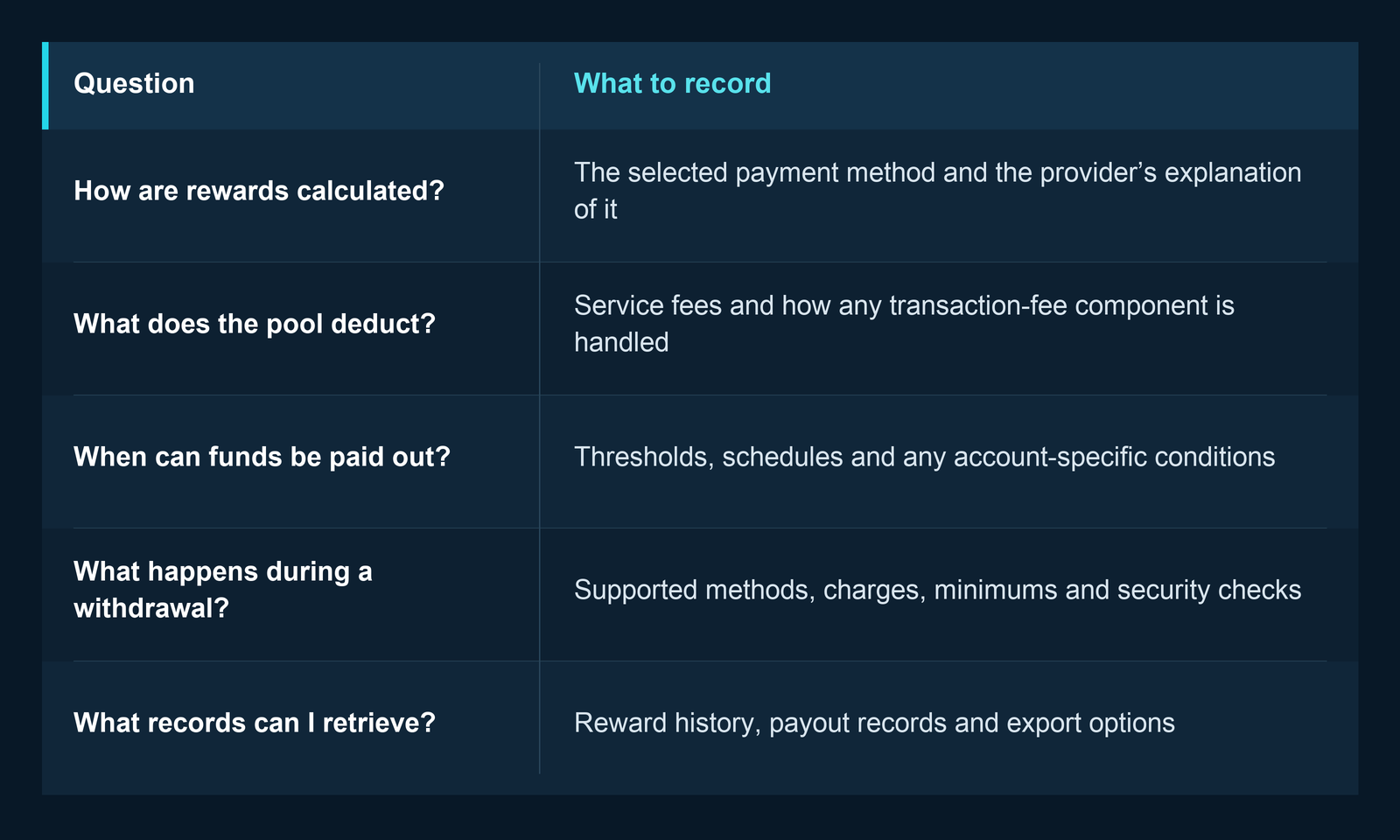
Separate reward calculation, balance crediting and external payment. The reward method determines how your mining work is rewarded and can affect short-term earnings variability. Balance crediting determines when those rewards appear in your pool account, while payout thresholds and schedules affect when funds can leave it. A credited pool balance does not mean the funds have reached your external wallet. If any of these steps is unclear, ask support before committing more machines.
Avoid treating a percentage copied from an old comparison as a current quote. Use the provider’s live terms and the settings actually available to your account when making the final decision.
Judge reliability through evidence you can check
“Stable” and “reliable” are not useful comparison labels unless you know what they refer to. Make the evaluation concrete: can your miner stay connected, does the pool accept its work, can you see a problem, and do you know what to do next?
Use four checks:
- Connection behavior: Record disconnects and failed connections during a controlled test.
- Accepted work: Confirm that shares are accepted under the correct worker.
- Visibility: Check whether each device is identifiable and whether useful alerts reach the responsible person.
- Recovery: Test the documented alternate connection and decide whether you need an independent backup pool.
An alternate port on one pool is not the same as independent pool-level redundancy. Keep that distinction in your checklist rather than counting every saved address as a separate protection.
Do not award a pool a perfect reliability score because a short test went well. Treat the test as a compatibility and operational check, then continue monitoring after the move.
Run a fair connection test
Keep the miner, firmware and operating conditions as comparable as possible, and record when each test runs. If conditions change, note the change instead of attributing every difference to the pool.
Check active connections and accepted shares first, then compare hashrate using appropriate, comparable reporting windows. Do not select a winner from a single dashboard screenshot.
The official monitoring guidance itself can differ: ViaBTC recommends checking its Workers and Earnings pages after about 10–15 minutes of stable operation, while Braiins says its dashboard can take up to an hour to show the full hashing power of a newly connected device. These are provider-specific reporting instructions, not a speed ranking or a promise about payouts.
Choose around your actual operating needs
Use your own constraints to interpret the shortlist. A feature matters only if it solves a problem you need to manage.
- For a small setup: Prioritize understandable configuration, clear payout requirements and a worker view you can check without specialist help.
- For a hosted operation: Prioritize named device records, a documented handover and a clear split of responsibility with the host.
- For a larger fleet: Prioritize per-device visibility, useful alerts, a staged rollout and a tested recovery procedure.
- For a site with connection problems: Test the available endpoints from that site before drawing a conclusion from someone else’s experience.
After choosing, move one machine or a small group first. Confirm that the new pool accepts its shares under the correct worker before moving the remaining machines, and replace retiring Binance entries in your backup configuration before the shutdown.
Save any Binance Pool records you need before its historical pages become inaccessible on November 24, 2026, at 07:00 UTC. Follow the official shutdown instructions for any eligible remaining rewards or settlements.
Frequently asked questions
Which pool is the best replacement for Binance Pool?
There is no single recommendation that removes the need to check your equipment, location, account eligibility and payment preferences. Start with documented candidates, then choose the one that passes your operational checks and has terms you understand.
Should I automatically pick the lowest-fee option?
No: compare the full set of payment and withdrawal conditions, then decide how much weight to give the quoted fee. Put the exact terms next to your connection-test findings rather than choosing on one number.
Can I leave Binance configured as a backup?
Not as a post-shutdown fallback: Binance says its endpoints will be disabled on November 10 at 07:00 UTC. Replace retiring entries with compatible, tested connections before that time.
Where ViaBTC may fit your shortlist
If your priorities include documented setup, worker visibility and notifications, ViaBTC is worth evaluating against the same criteria as the other candidates. Its BTC guide provides primary and alternate ports and worker-status instructions, while its alert guide describes hashrate and rejection-rate notifications through email, app push and Telegram.
Those capabilities can support your monitoring and connection-recovery workflow; they should not be treated as proof of zero downtime or better performance than every other pool. Read the official ViaBTC BTC setup guide, check your account’s current terms and start with a single-miner test.